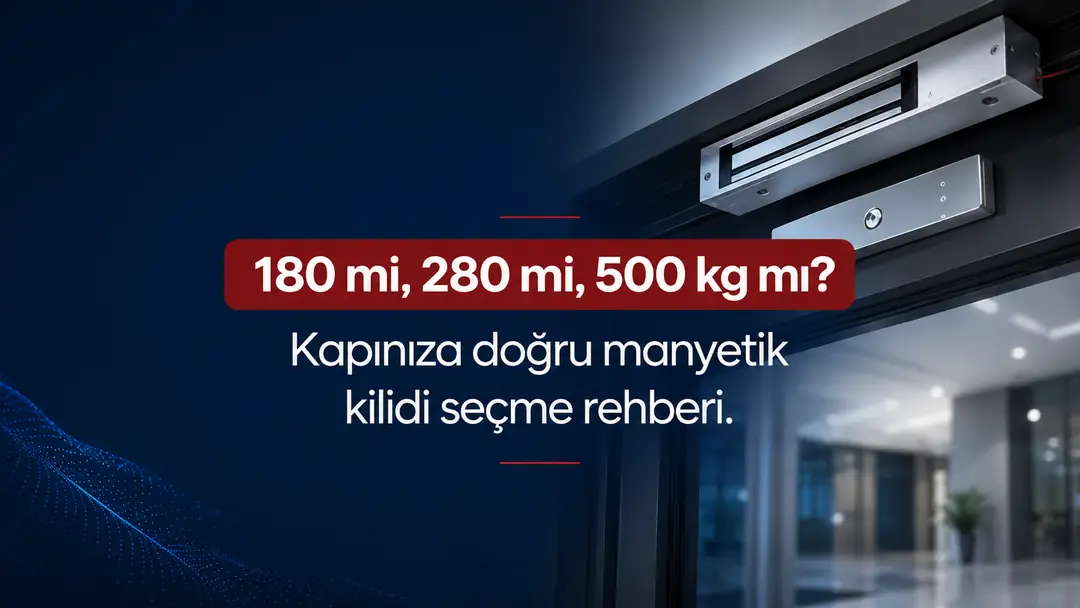
Choosing a magnetic lock comes down to three questions: how much force will the door take, how will the lock attach to the door, and what should happen when power is cut? A 180/280/500 kg comparison, a ZL bracket guide, a power calculation and three budget packages with prices.
Contents
- What is a magnetic lock and how does it work?
- How many kg should your magnetic lock be? 180 / 280 / 500 compared
- Z, L, ZL and U brackets: which mounting for which door?
- Fail-safe or fail-secure? The fire and escape route rule
- A magnetic lock alone isn't enough: the complete bill of materials
- Power and wiring: 12V or 24V, how many amps?
- Installation step by step
- The 10 most common mistakes
- Budget: material packages for three scenarios
- Troubleshooting and maintenance
- Which model for whom? Decision table
- Featured products
- Frequently asked questions
- Conclusion: choose the right magnetic lock with three questions
Choosing a magnetic lock comes down to one question: what holding force do the door's weight, traffic level and risk of forced entry call for? For a standard apartment building or office entrance door, 180 kg of holding force is usually enough; busy business centers, glass doors and exterior entrances call for 280 kg, and warehouse and factory doors and high-security points call for 500 kg. But the choice doesn't end with the lock: the wrong mounting bracket (Z, L, ZL, U) can leave even a 500 kg lock useless, and the wrong operating principle (fail-safe / fail-secure) creates a life-threatening risk in a fire. In this guide you'll find the holding force calculation, bracket selection by door type, power and wiring details, a complete bill of materials and three separate budget scenarios, all based on real product data.
For a standard single-leaf wooden or metal door, a 180 kg magnetic lock is enough. If the door weighs more than 100 kg, sees more than 200 passages a day or faces the exterior, step up to 280 kg. For glass doors, double doors, warehouses and high-security points, choose 500 kg. In all three models, the lock operates fail-safe: when power is cut, the door opens.
What is a magnetic lock and how does it work?
A magnetic lock is a door locking system with no moving parts: an electromagnet block that becomes magnetized when energized pulls against a steel armature plate fixed to the door. It is also known as an electromagnetic lock or maglock. The lock body is mounted on the door frame (the top frame) and the armature plate on the door leaf; when the door closes, the two surfaces touch and the magnetic field engages to lock the door.
This is its biggest difference from mechanical locks: there is nothing inside that turns, rubs or breaks. The locking is done by the magnetic field alone. That's why magnetic locks don't suffer mechanical wear, require no maintenance and, when wired correctly, complete tens of thousands of open/close cycles without trouble.
What exactly does holding force (kg) measure?
Holding force is the force required to separate the armature plate from the lock in the pulling direction (perpendicular to the surface). A 180 kg lock means it takes roughly 180 kilograms of force to pull the plate straight off. International catalogs give the same value in pounds (lbs):
- 180 kg = 300 lbs — standard interior and entrance doors
- 280 kg = 600 lbs — heavy traffic, exterior entrances, glass doors
- 500 kg = 1,200 lbs — warehouses, factories, high security
What do the technical terms on a magnetic lock mean?
Three terms you'll come across in product descriptions directly determine a lock's quality. Knowing them helps you understand the difference between two products that look alike:
- Anti-residual magnetism: A design that clears the residual magnetization left in the electromagnet after power is cut. Without this feature, the door stays "stuck" for a second or two even though the power is off, and the user has to strain to push it open. The SR-280 280 kg magnetic lock and the 500 kg model have this technology.
- MOV reverse current protection: A varistor that absorbs the reverse voltage spike (back-EMF) generated the moment the coil is de-energized. This protection safeguards the relay and control board of the card reader that triggers the lock. In systems without an MOV, the most common failure isn't the lock but a burned-out reader relay.
- NO / NC / COM output: A dry contact signal that reports the lock's door status (locked / open) externally. Thanks to this output, the door status can be connected to an alarm panel, door intercom or building automation system. All SR-180, SR-280 and SR-500 models have NO / NC / COM / + / − terminals.
Another practical detail: the 280 kg and 500 kg models have an LED status indicator on the lock body. A red LED shows the lock is open, a green LED that it is locked. After installation, the quickest way to check whether you have wired everything correctly is to look at this LED.
Magnetic lock vs. mechanical lock
| Criterion | Magnetic lock | Mechanical / cylinder lock |
|---|---|---|
| Moving parts | No | Latch, spring, cylinder, barrel |
| Wear | No mechanical wear | Latch and spring fatigue over time |
| When power is cut | Door opens (fail-safe) | Stays locked |
| Copying risk | No physical key | Key can be duplicated |
| Card/PIN integration | Direct, standard | Requires an extra motor/actuator |
| Fire code compliance | Suitable in the escape direction | Requires a panic bar |
| Continuous power requirement | Yes (to stay locked) | No |
| Quietness | Completely silent | Click/slam noise |
Is a magnetic lock really secure?
When chosen in the right class and installed correctly, a magnetic lock is harder to defeat than a mechanical lock, because there's no cylinder to break, no latch to turn with a screwdriver and no key to copy. The system's weak points aren't in the lock itself; they are concentrated at four points around it, and all four can be solved through design:
- Power line: If the lock cable is accessible from outside, it can be cut to open the door. The solution is to run the power cable through the frame in a protected conduit.
- Exit button: An exit button that can be reached from outside the door makes the whole system pointless. The button must always be on the inside.
- Card security: Easily duplicated key fobs weaken the door not physically but through identity. At sensitive points, non-copyable series cards or a card + PIN combination are used.
- Installation quality: An armature plate that sits crooked takes away a significant share of the rated holding force. The figure on the lock's label only holds with full surface contact.
The only "minus" row in the table is the continuous power requirement, and this is actually a deliberate result of safety design. The lock opening when it loses power is the desired behavior in fire and evacuation scenarios. We cover this topic in detail in the fail-safe section.
How many kg should your magnetic lock be? 180 / 280 / 500 compared
For a standard single-leaf wooden or metal door under 90 kg, 180 kg is enough; if the door weighs 90–150 kg, daily passages exceed 200 or the door faces outside, choose 280 kg; for glass doors, double doors, warehouses/factories and high-security points, go with 500 kg. Four variables drive the choice: door weight, traffic density, risk of forced entry and the environment the door is in.
Technical comparison of the three models
| Feature | SR-180 (180 kg) | SR-280 (280 kg) | SR-500 (500 kg) |
|---|---|---|---|
| Holding force | 180 kg (300 lbs) | 280 kg (600 lbs) | 500 kg (1,200 lbs) |
| Lock dimensions | 170 × 40 × 21 mm | 250 × 48 × 29 mm | 265 × 72 × 40 mm |
| Armature plate | 130 × 33 × 9.3 mm | 190 × 45 × 11 mm | 185 × 60 × 13 mm |
| Net weight | 1.08 kg | 1.84 kg | 4.22 kg |
| Supply voltage | 12V / 24V DC adjustable | 12V / 24V DC adjustable | 12V / 24V DC adjustable |
| Operating principle | Fail Safe | Fail Safe | Fail Safe |
| LED status indicator | — | Yes (red/green) | Yes (red/green) |
| MOV + anti-residual | — | Yes | Yes |
| Signal output | NO/NC/COM/+/− | NO/NC/COM/+/− | NO/NC/COM/+/− |
| Warranty | 24 months | 24 months | 24 months |
| Price | For the current price, check the product page. | ||
What stands out in the table is this: the price difference between 180 kg and 280 kg is small. In return, the 280 kg model also comes with an LED status indicator, MOV reverse current protection and an anti-residual magnetism design. Whenever you're on the borderline, moving up to 280 kg is a sensible choice for both holding force and electronic protection. Moving to 500 kg, however, is a serious jump: the price rises noticeably and the lock reaches 4.22 kg, a weight that can cause mounting problems on slim aluminum frames.
Quick selection by door type
| Door / use | Recommended model | Why |
|---|---|---|
| Apartment building entrance door (single leaf, metal) | 180 kg | Moderate door weight and forced-entry risk; cost/performance balance |
| Office interior door, meeting room | 180 kg | Light leaf, low forced-entry risk |
| Business center main entrance | 280 kg | Heavy foot traffic, wind pressure, heavy leaf |
| Glass door (single leaf) | 280–500 kg | Glass leaves are heavy; mounting requires a U bracket |
| Server room, vault room, archive | 500 kg | Maximum resistance to forced entry |
| Warehouse / factory door | 500 kg | Heavy leaf, rough use, industrial environment |
| Double-leaf door | 1 per leaf | A single lock won't hold the second leaf; two separate locks are a must |
| Fire door / escape route | 180–280 kg + emergency button | Fail-safe mandatory; designed together with an emergency exit button |
Is too much holding force harmful?
No, it does no harm security-wise, but it has three practical consequences. First, cost: a 500 kg lock is noticeably more expensive than the 180 kg model. Second, weight: the 4.22 kg body needs extra reinforcement on slim-profile aluminum or PVC frames. Third, power: a stronger coil draws more current, which scales up your power supply and backup power planning. Choosing the class the door actually needs is the right approach for both budget and ease of installation.
The price difference between 180 kg and 280 kg is small — but the 280 kg model also comes with an LED status indicator, MOV reverse current protection and anti-residual magnetism. Source: Geçiş Kontrol AVM product pages
Z, L, ZL and U brackets: which mounting for which door?
Whenever a magnetic lock can't be screwed directly to the door frame and leaf, you need a mounting bracket; ZL bracket sets are used on wooden and metal doors, and U brackets on glass doors. The bracket positions the lock and armature plate in correct alignment so they make full surface contact. The wrong bracket causes the lock to lose most of its rated holding force: a 280 kg lock can behave like a 100 kg one when the plate sits crooked.
When is no bracket needed?
Mounting without a bracket is only possible when all of these conditions are met at once: the door opens inward, the top inner surface of the frame has a flat area wide enough to take the lock body, and the top of the door leaf also has a flat surface for the armature plate. In a significant share of apartment and office doors in Türkiye, these three conditions are not met at the same time; especially on outward-opening doors and narrow-frame joinery, a bracket is almost always required.
Bracket types and where they're used
| Bracket | Where it mounts | Which door | Note |
|---|---|---|---|
| L bracket | On the top frame; carries the lock body | Wooden/metal doors without a flat mounting surface on the frame | Brings the lock down to door level |
| Z bracket | On the door leaf; carries the armature plate | Doors whose leaf surface isn't level with the lock | Aligns the plate parallel to the lock |
| ZL set | L + Z together | Most interior wooden and metal doors | The most common solution; 90° mounting angle |
| U bracket | Grips and clamps the glass leaf | Frameless glass doors | Allows mounting without drilling the glass |
ZL bracket dimensions and compatibility
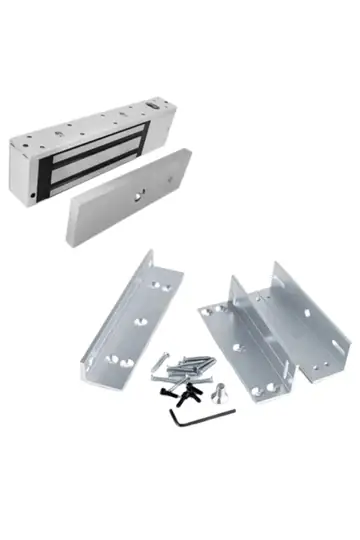
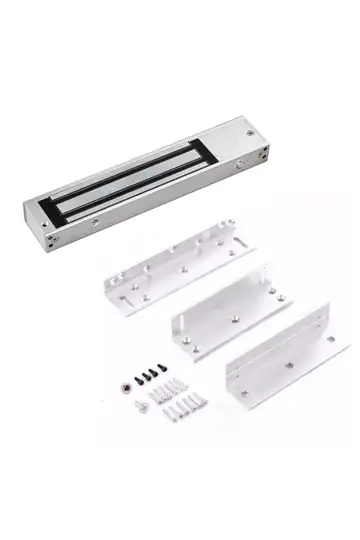
The bracket must match the lock's holding force class. A bracket made for a 180 kg lock won't carry a 280 kg lock; the dimensions and screw holes are different. In the SR-280 ZL bracket set, the L bracket measures 250 × 47 × 28 mm and the Z bracket 180 × 50 × 50 mm; it is made of anodized aluminum, suits a 90° mounting angle and is CE / MA certified. For the 180 kg class, the SR-180 ZL bracket is used; it has a high-strength aluminum construction, weighs 0.75 kg and is designed for indoor wooden and metal doors.
Buy separately or as a set?
If you know your door will need a bracket, a set is both cheaper and safer. Here's which products to choose in each class:
| Class | Lock (separate) | Bracket (separate) | Set (lock + bracket) |
|---|---|---|---|
| 180 kg | SR-180 | SR-180 ZL | SR-180+ZL set |
| 280 kg | SR-280 | SR-280 ZL | SR-280+ZL set |
In both classes, buying the set is more advantageous than buying the lock and bracket separately; for the current price, check the product page. What's more, buying the set eliminates the chance of the bracket turning out to be incompatible with the lock. The SR-180+ZL set and SR-280+ZL set ship the lock and bracket in a single package. In the 500 kg class, the SR-500 magnetic lock set is offered on the same principle; because the bracket in this set is made of stainless steel and a durable alloy, it works with wooden, glass and metal doors.
Mounting on glass doors: what to watch for
On frameless glass doors the glass can't be drilled, so a U-type bracket grips and clamps the glass and carries the armature plate. On glass doors, watch these three points:
- Glass thickness: The bracket's clamping range must match the thickness of the glass. The common range in the industry is 8–12 mm; don't order without measuring your door's glass.
- Leaf weight: Glass leaves are much heavier than wood. A 10 mm tempered glass door leaf can easily weigh 80–100 kg; that's why 280 kg is considered the minimum for glass doors.
- Hinge/pivot tolerance: Glass doors sag slightly over time. If more than 1 mm of gap remains between the plate and the lock at installation, holding force drops significantly; check the adjustment again one week after installation.
An alternative solution for glass doors is bolt-type systems such as the SR-580 solenoid bolt electric lock; it can be used on wooden, glass, metal, PVC and fire doors and is rated for 100,000 open/close cycles.
Fail-safe or fail-secure? The fire and escape route rule
A fail-safe lock opens when power is cut; a fail-secure lock stays locked when power is cut. Fail-safe is used on escape routes and fire exit doors; fail-secure is preferred at points such as vault rooms, archives and warehouses that must stay closed even during a power outage. In access control design, this distinction is the most frequently overlooked issue and the one with the most serious consequences.
All magnetic locks are fail-safe by design. Because the magnetic field does the locking, the field disappears the instant power is cut and the door is released. The product pages of the SR-180, SR-280 and SR-500 models state this principle explicitly as "Fail Safe (open when unpowered)". Power outage, fire alarm trigger or a press of the emergency exit button: whichever happens, the result is the same — the door opens.
On every door along an escape route, the lock must open by itself when power is cut. Magnetic locks meet this requirement naturally. A magnetic lock used in the escape direction must always be designed together with an emergency button, wired so that the button directly cuts the lock's power line.
Comparing the two principles
| Criterion | Fail-safe (NC) | Fail-secure (NO) |
|---|---|---|
| When powered | Locked | Open |
| When power is cut | Opens | Stays locked |
| Relay connection | To the NC terminal | To the NO terminal |
| Power consumption | Continuous (to stay locked) | Only when opening |
| Escape route suitability | Suitable | Not used in the escape direction |
| Typical product | Magnetic lock (SR-180 / 280 / 500) | Electric strike lock (SR-550 NC) |
| Where used | Apartment building entrance, office, fire door, evacuation route | Vault room, archive, outdoor storage, technical room |
When does an electric lock alternative make sense?
At points where the door must stay closed during a power outage, a magnetic lock is not the right choice. That's where an electric strike lock or solenoid bolt lock comes in. The SR-550 NC electric strike lock provides 280 kg of holding force, runs on 12V DC and draws only 200 mA; in other words, it runs on far less power than a magnetic lock, because it doesn't need to be energized continuously. Its moving part is stainless steel; it is used on wooden, metal and PVC doors and operates between −10°C and +55°C.
Why is the emergency button non-negotiable?
Every magnetically locked escape door must have an emergency button that directly cuts the lock's power line. This button must work independently of the card reader, panel or software, because in an emergency the first thing that may fail is the electronic control layer itself. Break glass fire alarm buttons are made for exactly this job:
- SR-703 fire alarm break glass call point — thanks to its DPDT / 2NO / 2NC / 2COM contact configuration, it can cut the lock and send a signal to the alarm panel at the same time. It features 3A / 125–250 VAC switching, an 86 × 86 × 61 mm housing and automatic reset.
- SR-704 resettable break glass call point — SPDT / NO / NC / COM contact; the breakable glass design reduces the risk of accidental activation, and after use it is reset and put back into service. 86 × 86 × 52 mm, 165 g.
Both buttons are made of fire-resistant material and operate between −10°C and +55°C at 0–95% relative humidity. The practical rule for positioning the buttons is: a person evacuating should not have to search for the button when they reach the door. Mount it right next to the door handle, close to eye level.
A magnetic lock alone isn't enough: the complete bill of materials
A working door needs at least five components: the lock, a mounting bracket, an authentication device (card reader or button), an exit button on the inside and a power supply. Ordering a magnetic lock on its own and thinking "I'll just install it and it'll work" is the most common reason installations get stuck halfway. The table below shows, function by function, what a door needs from start to finish.
| Component | Function | Required? | Example product |
|---|---|---|---|
| Magnetic lock | Locks the door | Yes | SR-180 |
| ZL / U bracket | Holds the lock in correct alignment | Depends on the door structure | SR-180 ZL |
| Card reader | Opens for authorized entry from outside | Yes, in card systems | SR-209 EM-W |
| Exit button | Opens the door from inside | Yes | SR-722 |
| Emergency button | Cuts the lock's power | Yes, on escape routes | SR-704 |
| Power supply | 12V / 24V DC power | Yes | Chosen based on existing infrastructure |
| Voltage converter | Powers 12V devices from a 24V line | In mixed systems | SR-251 |
| Card / key fob | User credential | Yes, in card systems | Based on the number of users |
| Cable | Power and signal | Yes | Cross-section chosen by distance |
Card reader, keypad or fingerprint?
The authentication layer determines how convenient the system is in everyday use. All three approaches have their place:
- Card only: The standard for apartment building and residential complex entrances. The SR-209 EM-W proximity card reader works with 125 kHz EM card technology, offers a capacity of 10,000 users and has an IP68, anti-vandal metal housing, so it can be used at exterior points exposed to rain and impact. Read time is under 20 milliseconds.
- Card + PIN: For offices and business centers that want a second layer of verification. A user who loses their card can't get through without the PIN.
- Fingerprint + card + PIN: For staff tracking and high-security points. The SR-212 EM biometric reader has a capacity of 300 fingerprints and 10,000 cards/codes; door open time is adjustable from 0–99 seconds, and the card reading distance is 2–5 cm.
All three readers can work standalone (on their own, with their own memory) and can also connect to a central access control panel through their Wiegand output. If you're buying for a single door today but plan to move to a building-wide system tomorrow, choosing a model with Wiegand output saves you from replacing devices later.
Exit button: push or no-touch?
Nobody wants to scan a card to exit from inside; that's what the exit button is for. The difference between the two options comes down to usage intensity and hygiene. The SR-722 stainless steel exit button is a mechanical push type; it is tested for 500,000 presses, its stainless steel front panel resists impact and scratches, and it operates between −20°C and +55°C. The SR-705 no-touch door release button, on the other hand, works with an infrared sensor; it is preferred in hospitals, laboratories, food production and busy office entrances because it requires no hand contact. Both offer NO / NC / COM contacts and connect directly to the magnetic lock line.
Card or key fob? Choosing the user credential
Once you have chosen the lock and reader, it's time for the credentials, the everyday face of the system. Key fobs are preferred in apartment buildings and residential complexes, cards in corporate buildings, because a photo, name and logo can be printed on a card, while a key fob stays in a pocket or on a key ring. The choice between the two technologies depends on your security needs:
- 125 kHz EM (proximity): The most common standard in Türkiye. Economical and compatible with every reader; however, its writable types can be easily duplicated.
- 13.56 MHz Mifare: A newer and more secure technology; because data can be written to the card, it lends itself to hotel, staff and payment applications.
- Non-copyable series: Key fobs manufactured to resist duplication are the right choice for apartment building managements that want to prevent cards from being duplicated without the residents' knowledge.
The practical approach: if you know the number of users, buy a bulk pack. In the store, key fobs are sold in packs of 50, 100, 250, 500 and 1,000, and these packs come with a free card copier. A 40-unit apartment building needs 80 fobs at 2 fobs per unit; buying them in a pack of 100 instead of one by one lowers both the unit cost and the number of shipments.
Wiring logic: which terminal goes where?
A magnetically locked door has four separate lines, and their roles must not be mixed up. Keep this logic in mind as you plan the installation:
- Power line: Power supply → emergency button → reader/panel relay (NC terminal) → lock. It is critical that the emergency button sits at the start of this chain; when the button is pressed, the entire line is cut and the lock cannot be energized under any circumstances.
- Trigger line: When the card reader reads a valid card, it switches its relay for the set time (adjustable from 0–99 seconds on the SR-212); power is cut, the door opens, and when the time is up the lock re-engages.
- Exit button line: The normal exit button connects to the reader's button input and triggers the same relay. This way, the lock is also released for a set time when someone exits from inside.
- Status monitoring line: The lock's NO/NC/COM terminals are used to report the door status to an alarm panel or building automation system. If you won't use them, leave these terminals unconnected; don't confuse them with the power terminals.
Power and wiring: 12V or 24V, how many amps?
Use 12V for short distances (under 10 meters) and 24V for installations with long cable runs. The SR-180, SR-280 and SR-500 models can all be set to run on 12V or 24V DC. The difference shows up in the current drawn and the voltage drop along the cable.
How much current does a magnetic lock draw?
A magnetic lock draws current continuously for as long as it stays locked. This is the basis of the power supply calculation:
| Model | Current at 12V | Current at 24V | Power (approx.) |
|---|---|---|---|
| 180 kg class | 300 mA | 150 mA | 3.6 W |
| 280 kg class | 500 mA | 250 mA | 6.0 W |
| Electric strike lock (SR-550) | 200 mA (only when opening) | — | 2.4 W (momentary) |
| Solenoid bolt (SR-580) | 900 mA pull-in / 100 mA steady | — | 10.8 W momentary |
There's a hidden cost lesson in this table. The 280 kg magnetic lock draws 500 mA at 12V, and it does so 24/7. Annual consumption comes to about 52.6 kWh (6 W × 8,760 hours). Negligible for a single door, but in a business center with 20 doors it reaches 1,050 kWh a year. If you power the same lock at 24V, the current is halved; the power stays the same, but the loss along the cable drops to a quarter.
How many amps should the power supply be?
The simple rule: add up the total current of all devices and add a 30% margin on top. A typical single-door installation at 12V adds up like this:
- Magnetic lock (280 kg): 500 mA
- Card reader: per the device label, typically 100–300 mA
- Exit button, emergency button: negligible (passive contact)
- Total: about 800 mA → with a 30% margin, 1.04 A
In this case, a 12V / 2A power supply runs comfortably. Pay attention to the value printed on card reader labels: the operating voltage of the SR-209 and SR-212 models is given as DC 12V / 3A. This doesn't mean the device draws 3 amps; it means the power supply should be in this class. Still, choosing the power supply based on this value is the safest approach.
24V infrastructure, 12V device: when do you need a converter?
Turnstiles, automatic doors and some building automation panels distribute power over 24V. Connecting a 12V card reader or lock to this line burns out the device. The SR-251 voltage converter module takes a 24V AC or DC input and delivers a stable 12V DC output; it works with card readers, fingerprint readers, keypad access devices, electromagnetic locks, turnstiles and elevator access systems. This small module costs far less than a card reader that the wrong voltage could burn out; preventing even a single failure more than pays for it.
Cable cross-section and voltage drop
The sneakiest fault in a magnetic lock is that it "sometimes doesn't hold", and the cause is usually thin cable. Over long distances, cable resistance creates a voltage drop; 10.5V reaches the lock instead of 12V, and holding force drops noticeably. Practical recommendations:
- 0–10 m: 2 × 0.75 mm² is sufficient.
- 10–25 m: 2 × 1.0 mm², or switch to 24V power.
- Over 25 m: 2 × 1.5 mm² and 24V power if possible; or move the power supply closer to the door.
- Run power and signal cables separately; interference from the lock coil can corrupt the reader signal.
- Don't connect a relay without MOV/diode protection to the lock line. The SR-280 and SR-500 models have a built-in MOV; on the 180 kg model, it's worth taking extra measures to protect the relay.
If the power goes out, will the door stay open?
Yes, and this is by design. However, at points where security must also be maintained, such as an apartment building entrance, this isn't desirable. The solution is to choose a power supply with battery backup. A 7 Ah battery powers a 280 kg lock at 12V for about 14 hours (7 Ah ÷ 0.5 A). The same battery keeps a 180 kg lock going for about 23 hours. In a fire scenario, however, the system must open the door; that's why, in battery-backed systems, the fire alarm relay must be wired to cut the lock's power even while the battery is in use.
A 280 kg magnetic lock draws 500 mA at 12V and does so without interruption; its annual consumption is about 52.6 kWh. Switching to 24V power halves the current and cuts cable loss to a quarter. Source: SR-280 manufacturer datasheet values (12V/500 mA, 24V/250 mA)
Installation step by step
A properly done magnetic lock installation takes 60–90 minutes on average, and the most critical stage is aligning the lock and armature plate exactly opposite each other. The sequence below applies to a single-leaf, inward-opening door; for glass doors and double doors, the bracket steps change.
- Take measurements. Measure the flat area the lock body needs on the top inner surface of the frame. If there isn't enough room, plan an L bracket; if the leaf surface isn't level, plan a Z bracket.
- Determine the position. The lock is mounted at the top corner of the door opposite the hinges. Mounting near the hinges reduces holding force through leverage, a mistake that on its own can cause a performance loss of up to 40%.
- Mark the template. Stick the drilling template from the box onto the frame and leaf and mark the hole positions. If there's no template, hold the lock and plate in place and mark with a pencil.
- Plan the cable route. Prepare the channel that will bring the power cable to the lock body in advance. Route the cable through the frame so that door movement doesn't affect it; cables running over the leaf break over time.
- Drill and fix the bracket. Use a metal drill bit on metal frames and a wood bit on wood. When tightening the bracket, tighten the screws gradually in a crisscross pattern.
- Mount the lock body. Set the voltage selection jumper (12V/24V) before mounting; it's hard to reach once the body is installed.
- Fit the armature plate. The plate must be mounted flexibly: the rubber washer and center screw arrangement let the plate seat fully against the lock face when the door closes. Overtightening the plate distorts the contact surface and reduces holding force.
- Connect the cables. Connect the lock's +/− terminals to the power line and the NO/NC/COM terminals (if you'll use them) to the status monitoring line. For fail-safe operation, the lock is powered through the NC terminal of the control relay.
- Wire in the buttons. The normal exit button triggers the relay; the emergency button directly cuts the power line. Don't mix up these two lines.
- Test. Close the door and check the LED (green = locked). Try pulling the door. Press the exit button, scan a card, and test the emergency button last. After each test, confirm that the door locks again on its own.
- Check again after a week. Door hinges settle and screws may loosen. Recheck the gap between the plate and the lock and how tight the screws are.
The 10 most common mistakes
The vast majority of problems in magnetic lock installations stem not from the product but from selection and installation decisions. The list below consists of ten points you can check before you buy.
- Not accounting for the bracket. The lock arrives, can't be mounted on the door, and the job waits a week. Measure the frame before ordering; if needed, order a set directly.
- Buying a single lock for a double door. The second leaf stays free and the door isn't actually locked. Each leaf needs its own lock.
- Mounting the lock on the hinge side. Leverage seriously reduces holding force. The lock always goes on the top corner opposite the hinges.
- Overtightening the armature plate. The plate must be mounted flexibly; rigid mounting prevents full surface contact, and holding force drops.
- Running thin cable. Voltage drop reduces the lock's strength. On runs longer than 10 meters, increase the cross-section or switch to 24V.
- Skipping the emergency button. On doors along escape routes, a button that directly cuts the lock's power is mandatory; it must work independently of the reader.
- Forgetting the exit button. A system that forces people to scan a card to get out soon leads to the door being left open.
- Fitting a fail-secure lock on an escape route. A lock that stays locked when power is cut is not used on an evacuation route.
- Choosing a power supply with no headroom. A power supply rated just above the total current runs unstably on hot summer days. Leave a 30% margin.
- Putting indoor products outdoors. Check the IP rating when choosing card readers and brackets. On exterior walls, use an IP68, anti-vandal metal housing (for example, the SR-209 EM-W) or a protective enclosure.
Budget: material packages for three scenarios
The cost of a complete single-door card access installation varies considerably with the lock's holding force class and the reader's authentication method. The three packages below are built around the most common scenarios. The power supply, cards/key fobs and cable are not included in the packages. For the current prices of the products in the packages, check the product page.
Package A — Apartment building entrance (economy)
| Product | Function |
|---|---|
| SR-180+ZL magnetic lock set | Lock + mounting bracket |
| SR-209 EM-W card reader | Exterior entrance, IP68 |
| SR-722 stainless exit button | Exit from inside |
| SR-704 emergency button | Cuts the lock's power |
Package B — Office and business center (balanced)
| Product | Function |
|---|---|
| SR-280+ZL magnetic lock set | Heavy traffic, LED + MOV |
| SR-212 EM biometric reader | Fingerprint + card + PIN |
| SR-705 no-touch exit button | Hygienic, infrared |
| SR-703 emergency button | DPDT — also signals the alarm panel |
Package C — Warehouse, archive and high security
| Product | Function |
|---|---|
| SR-500 magnetic lock set (+ZL) | 500 kg holding force, heavy leaf |
| SR-209 EM-W card reader | IP68 + anti-vandal |
| SR-722 stainless exit button | 500,000-press life |
| SR-703 emergency button | 2NO/2NC/2COM |
| SR-251 voltage converter | 12V power from 24V infrastructure |
Troubleshooting and maintenance
Since a magnetic lock has no moving parts, "breakdowns" are rare; most problems stem from power, alignment or contact. The table below shows the six symptoms most often seen in the field and their likely causes.
| Symptom | Likely cause | What to do? |
|---|---|---|
| Lock doesn't hold at all | No power, reversed polarity, jumper set to the wrong voltage | Measure the voltage at the lock terminals; check the 12V/24V selection jumper |
| Holds weakly, opens by hand | Plate misaligned, dirt/paint between the surfaces, low voltage | Clean the surfaces, adjust the plate's flexibility, increase the cable cross-section |
| Door sticks for a moment when opening | Residual magnetization (residual magnetism) | Switch to a model with an anti-residual design (280 kg and 500 kg class) |
| Lock gets warm | Some warming is normal; if it's excessive, the voltage is too high | Measure the supply voltage; values above 13.8V on a 12V line cause problems |
| Reader relay burned out | Reverse voltage spike (back-EMF) | Use an MOV-protected lock or add protection to the relay line |
| Card is scanned, but the door doesn't open | Relay wired to the NO terminal (fail-secure setup) | For a magnetic lock, power must pass through the relay's NC terminal |
5-minute maintenance to do twice a year
- Wipe the lock and armature plate surfaces with a dry cloth; dust, sand and paint residue reduce the contact area.
- Check the bracket and plate screws and tighten them if needed.
- Close the door and verify the LED (green = locked).
- Test the exit button and the emergency button one at a time.
- If the power supply has a battery, measure the battery voltage; on 12V batteries, a reading below 11.8V means it's time to replace the battery.
Magnetic locks are designed to operate between −10°C and +55°C at 0–90% relative humidity (non-condensing). On doors facing the exterior, positioning the lock body so it isn't directly exposed to rain noticeably extends its service life.
Which model for whom? Decision table
The table below gives a directly applicable recommendation for each user profile. Find the row closest to your situation and start with that configuration.
| Profile | Lock | Reader | Why |
|---|---|---|---|
| Apartment building management | SR-180+ZL set | SR-209 EM-W | Cost-balanced, easy card distribution, suitable for exterior walls |
| Residential complex / residence | SR-280+ZL set | SR-209 EM-W | Heavy traffic, heavy leaf, LED status monitoring |
| Office / office tower | SR-280+ZL set | SR-212 EM | Fingerprint + card + PIN for staff tracking |
| Warehouse / factory | SR-500 set | SR-209 EM-W | Heavy leaf, rough use, IP68 durability |
| Server / archive room | SR-550 NC (fail-secure) | SR-212 EM | Must stay closed even if power is cut; not an escape route |
| Store / clinic with glass doors | SR-580 solenoid bolt | SR-209 EM-W | Bolt solution for glass and PVC doors; 100,000-cycle lifespan |
| Installation / security company | Sets + multi-packs | Models with Wiegand output | Easy inventory management, scalable through panel integration |
Featured products
- −20% in packs
- −39% in packs
- −39% in packs
Frequently asked questions
How many kg should a magnetic lock be?
For standard single-leaf wooden or metal doors under 90 kg, 180 kg is enough. If the door weighs 90–150 kg, daily passages exceed 200 or the door faces the exterior, choose 280 kg. For glass doors, warehouses, factories and high-security points, 500 kg is preferred.
Does a magnetic lock open when the power goes out?
Yes. Magnetic locks operate fail-safe: because the magnetic field does the locking, the field disappears when power is cut and the door is released. This behavior is the desired outcome in fire and evacuation scenarios. Where security must be maintained, a power supply with battery backup is used.
Is a ZL bracket needed on every door?
No. If the door opens inward and there's a flat mounting surface on both the frame and the leaf, it can be mounted directly. However, outward-opening doors and narrow-frame joinery require a bracket. Measuring the top inner surface of the frame before ordering is the safest approach.
Can a magnetic lock be fitted on a glass door?
Yes. On frameless glass doors, it is mounted without drilling the glass, using a U-type bracket that grips it. Because glass leaves are heavy, 280 kg is considered the minimum. The bracket's clamping range must match the glass thickness; measure the glass thickness before ordering.
Should I wire it at 12V or 24V?
The SR-180, SR-280 and SR-500 models can be set to run at either voltage. On short runs under 10 meters, 12V is enough. If a longer cable will be run, choose 24V: the current is halved and the loss along the cable drops to a quarter.
How much electricity does a magnetic lock use?
At 12V, the 180 kg class draws about 300 mA and the 280 kg class 500 mA, and they do so continuously for as long as they stay locked. Annual consumption for the 280 kg model is about 52.6 kWh. With 24V power, the current is halved while the power consumed stays the same.
What's the difference between fail-safe and fail-secure?
A fail-safe lock opens when power is cut; a fail-secure lock stays locked. Magnetic locks are fail-safe and are used on escape routes. The SR-550 NC electric strike lock, on the other hand, operates fail-secure; it suits points that must stay closed, such as vault rooms, archives and technical rooms.
How many magnetic locks does a double-leaf door need?
One per leaf. A single lock holds only the leaf it's mounted on; the second leaf stays free and the door isn't actually locked. Double-leaf doors use either two separate locks or a dual lock made for double doors.
Why isn't my magnetic lock holding the door?
The three most common causes are: an armature plate that is misaligned or overtightened, dirt and paint residue on the contact surface, and voltage drop caused by thin cable. Mounting the lock on the hinge side also noticeably reduces holding force.
Is it better to buy the lock and bracket separately or as a set?
If you know you'll need a bracket, a set is the better choice. The set price is more advantageous than buying the lock and bracket separately; for the current price, check the product page. It also eliminates the risk of the bracket being incompatible with the lock class.
Conclusion: choose the right magnetic lock with three questions
What makes choosing a magnetic lock complicated is reducing the decision to a single number (kg). In reality, the right choice lies in the answers to three questions:
- How heavy is the door, and how much force will it face? This determines the holding force: 180, 280 or 500 kg.
- How will the lock attach to the door? This determines the bracket: direct mounting, a ZL set or a U bracket for glass.
- What should happen when the power goes out? This determines the operating principle: a fail-safe magnetic lock on escape routes, a fail-secure electric lock for rooms that must stay locked.
Once you have these three answers, all that is left is to add the complementary components: a card reader, an exit button, an emergency button and a power supply with the right amperage. The three budget packages in this guide directly cover most apartment building, office and warehouse scenarios; if your door is different from the ones listed, simply state your door type, dimensions and opening direction in the Q&A section on the product pages.
Because prices change with exchange rates and promotions, this guide does not give fixed prices; check the relevant product page for the current price. Technical values are based on manufacturer data. Locking doors on escape routes, integration with the fire detection system and the mains connection must be carried out by authorized persons.